
What Is Python and Why Is It So Trending?
Python has become one of the most popular programming languages because it is easy to learn, powerful, versatile, and widely used in web development, automation, data science, artificial intelligence, and many other fields.
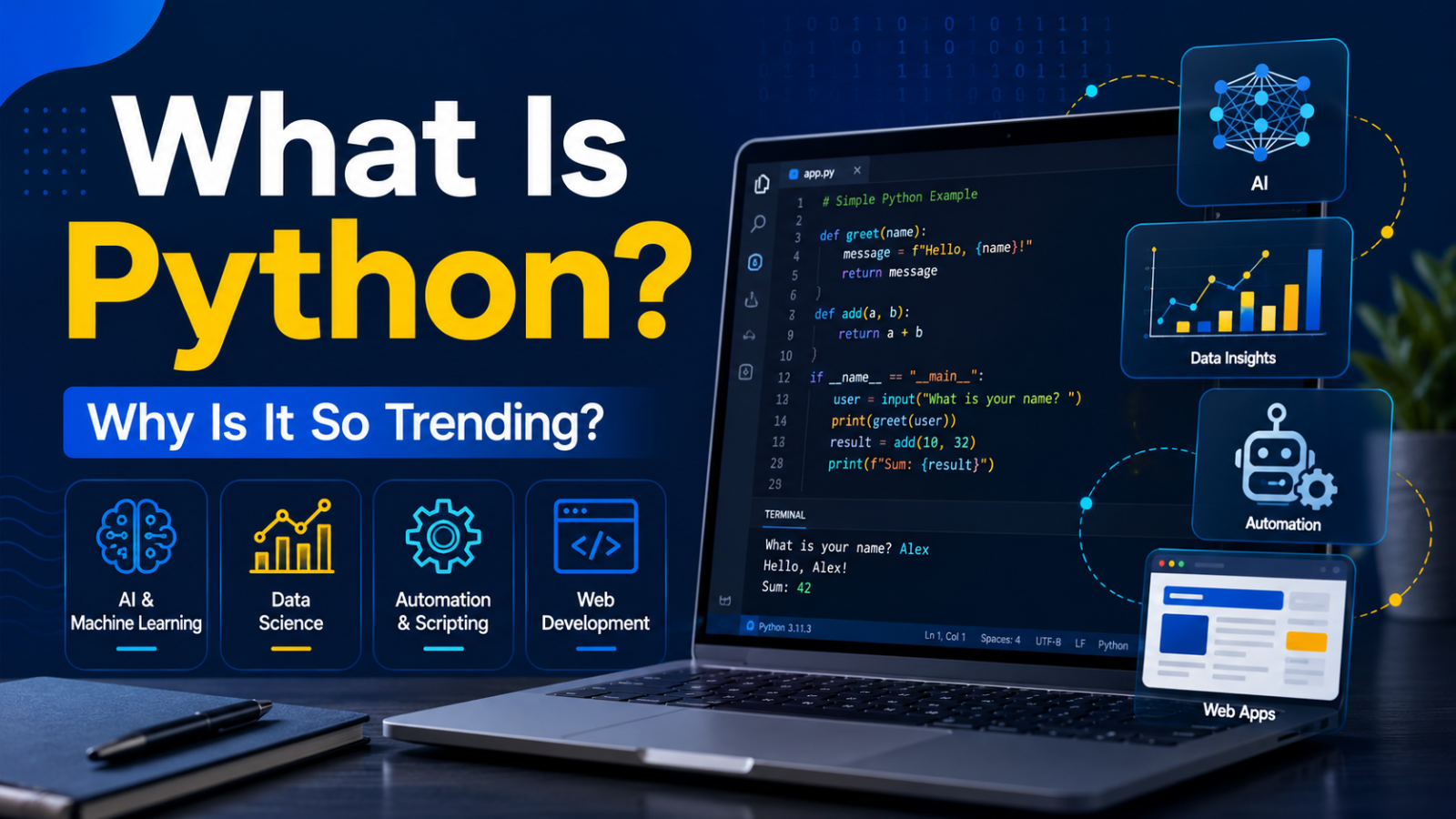
What Is Python?
Python is a high-level, general-purpose programming language known for its simple syntax and readability. It is widely used by beginners, professional developers, researchers, data analysts, automation engineers, and organisations around the world.
One of the biggest reasons for Python's popularity is that its code is comparatively easy to read and understand. This allows beginners to focus more on programming concepts and problem-solving instead of spending too much time learning complicated syntax.
Why Is Python So Popular?
Python is popular because it combines simplicity with powerful capabilities. A student can start by writing small programs and gradually move into advanced areas such as web development, automation, data science, machine learning, and artificial intelligence.
1. Python Is Beginner-Friendly
Python is often recommended as a first programming language because its syntax is clean and relatively easy to understand.
For example, displaying a message in Python is very simple:
print("Hello, World!")2. Python Is Used in Artificial Intelligence
Artificial Intelligence is one of the major reasons Python receives so much attention today. Python is widely used for developing and experimenting with AI and machine-learning applications.
Its ecosystem includes tools and libraries that help developers work with data, build models, perform calculations, and create intelligent applications.
Common AI-related areas include:
- Machine Learning
- Natural Language Processing
- Computer Vision
- Predictive Analytics
- Data-driven Automation
3. Python Is Widely Used in Data Science
Modern organisations generate large amounts of data. Python can be used to clean, analyse, visualise, and process data.
Students interested in analytics and data-oriented careers often learn Python because it can be combined with popular tools for numerical computing and data analysis.
4. Python Can Automate Repetitive Tasks
Automation is another practical use of Python. Small Python programs can perform repetitive activities that would otherwise require manual effort.
Examples may include:
- Renaming multiple files
- Organising folders
- Processing spreadsheets
- Generating reports
- Handling repetitive data operations
- Performing routine administrative tasks
5. Python Is Used for Web Development
Python can also be used to build websites and web applications. Developers can use Python-based frameworks to create backend systems, APIs, dashboards, portals, and other web services.
This makes Python useful for students who want to understand how dynamic websites and server-side applications work.
6. Python Has a Large Ecosystem
A programming language becomes more useful when developers have access to libraries, documentation, examples, and community support.
Python has a large ecosystem covering many areas, including:
- Web Development
- Data Analysis
- Artificial Intelligence
- Machine Learning
- Automation
- Scientific Computing
- Testing
- Networking
This allows developers to reuse established tools rather than building everything from the beginning.
7. Python Works Across Different Platforms
Python is available on major operating systems such as Windows, Linux, and macOS. This makes it convenient for students and developers working in different environments.
8. Python Is Useful Beyond Software Development
Python is not useful only for professional programmers. It is also used by people working in fields such as research, finance, education, analytics, engineering, and administration.
Someone may use Python primarily to automate calculations or analyse data without becoming a full-time software developer.
Why Is Python Trending Among Students?
Students are increasingly interested in Python because it connects naturally with several modern technology areas.
- Artificial intelligence is receiving significant attention.
- Data skills are becoming increasingly valuable.
- Automation can improve productivity.
- Python is relatively accessible for beginners.
- Many learning resources and projects are available.
- Python skills can support multiple technology career paths.
What Can You Build With Python?
A learner can use Python to create many different types of projects.
| Area | Example Project |
|---|---|
| Beginner Programming | Calculator, quiz program, number guessing game |
| Automation | File organiser or automated report generator |
| Data Analysis | Sales or student-performance analysis |
| Web Development | Dynamic website or web application |
| Artificial Intelligence | Basic prediction or classification project |
Is Python Enough to Get a Job?
Students should combine Python with other relevant skills depending on their chosen field.
For example:
How Should a Beginner Start Learning Python?
A beginner should start with the fundamentals and build practical projects gradually.
- Understand variables and data types.
- Learn operators and user input.
- Study conditions such as if and else.
- Learn loops.
- Understand functions.
- Work with lists, dictionaries, and other data structures.
- Learn file handling.
- Build small practical projects.
- Choose a specialisation such as web development, automation, data science, or AI.
Do You Need Advanced Mathematics to Learn Python?
However, certain specialised fields such as machine learning, artificial intelligence, scientific computing, and advanced data science may require stronger mathematical knowledge.
Python as a Career Skill
Python is valuable because it is not restricted to one specific type of job. A strong foundation in Python can support learning in several technology areas.
Students should focus on understanding programming logic and solving problems rather than simply memorising code.
Learning a programming language is most useful when you can apply it to solve practical problems.
Conclusion
Python is trending because it offers a combination of simplicity, flexibility, and practical usefulness. Beginners can start with basic programming while experienced developers can use the same language for advanced applications in web development, automation, data analysis, and artificial intelligence.
For students entering programming, Python can be an excellent starting point. The key is to learn the fundamentals, practise regularly, and build real projects instead of focusing only on theory.
Python sirf syntax seekhne ka naam nahi hai. Real progress tab hoti hai jab aap code ko practical problems solve karne ke liye use karte ho.
Article tags
Continue reading
Related articles
More practical insights from the XectiQ learning network.
Why Students Should Learn AI: Benefits, Skills, Career Opportunities & How to Start
Learn how Artificial Intelligence can help students in studies, research, coding, creativity, productivity and future careers. Understand how to learn AI responsibly and explore practical AI and computer courses with XectiQ.
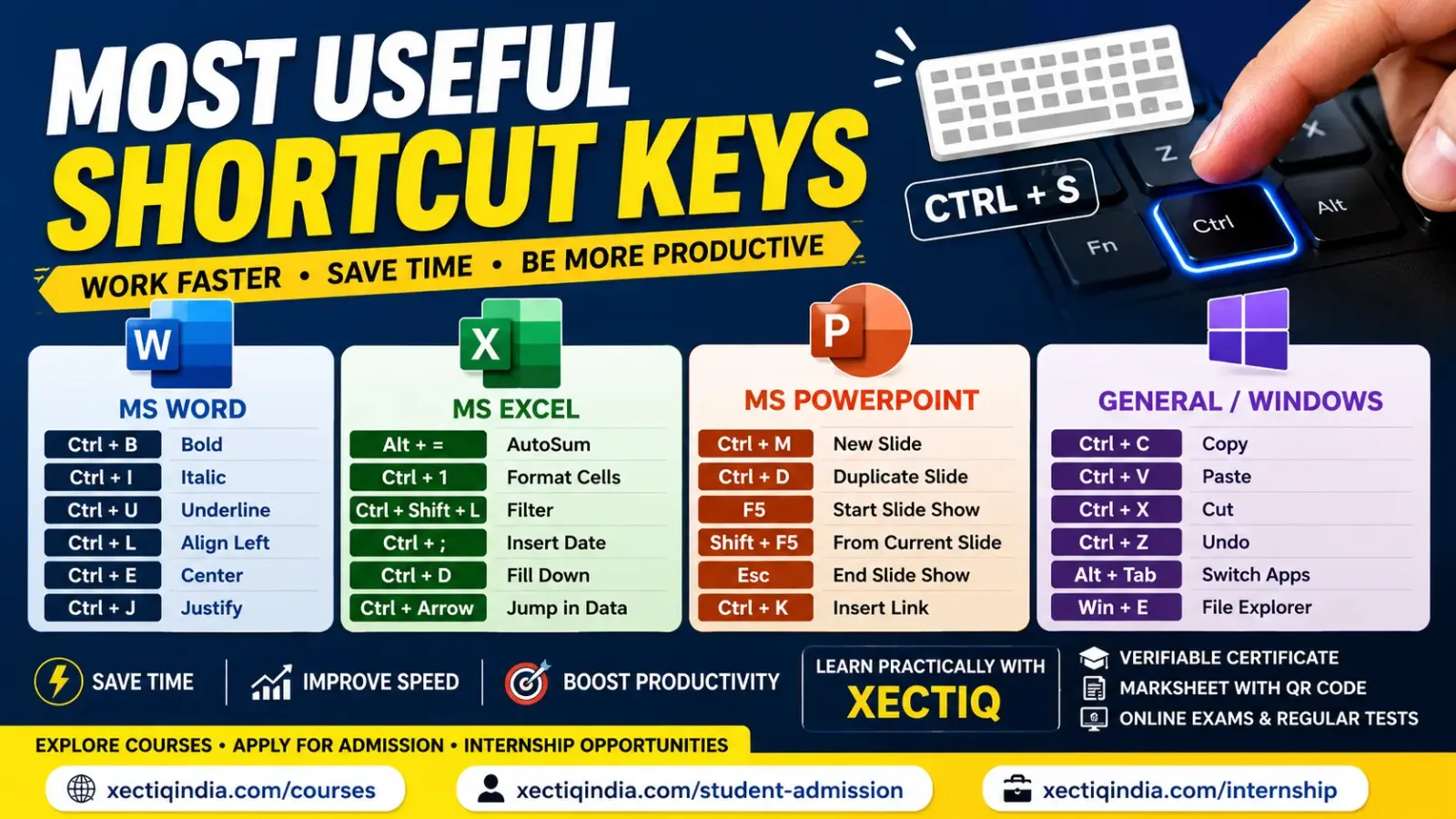
Most Useful Computer Shortcut Keys for Students – MS Word, Excel, PowerPoint & General Shortcuts
Learn the most useful keyboard shortcuts for MS Word, Excel, PowerPoint and general computer use. A simple student-friendly shortcut guide for faster typing, editing, calculations, presentations and everyday computer work.
 Featured
Which BCA Specialization Should You Choose? AI, Data Science, Cyber Security, Cloud or Full Stack – Complete Student Guide
Confused about which BCA specialization to choose? Compare AI & Machine Learning, Data Science, Cyber Security, Cloud Computing, Full Stack Development and BCA General with practical guidance based on your interests, skills and career goals.
Build practical skills
Turn learning into real capability.
Explore courses, internships and authorised XectiQ Centres.